
Beyond Surviving to Thriving
Feb 28, 2026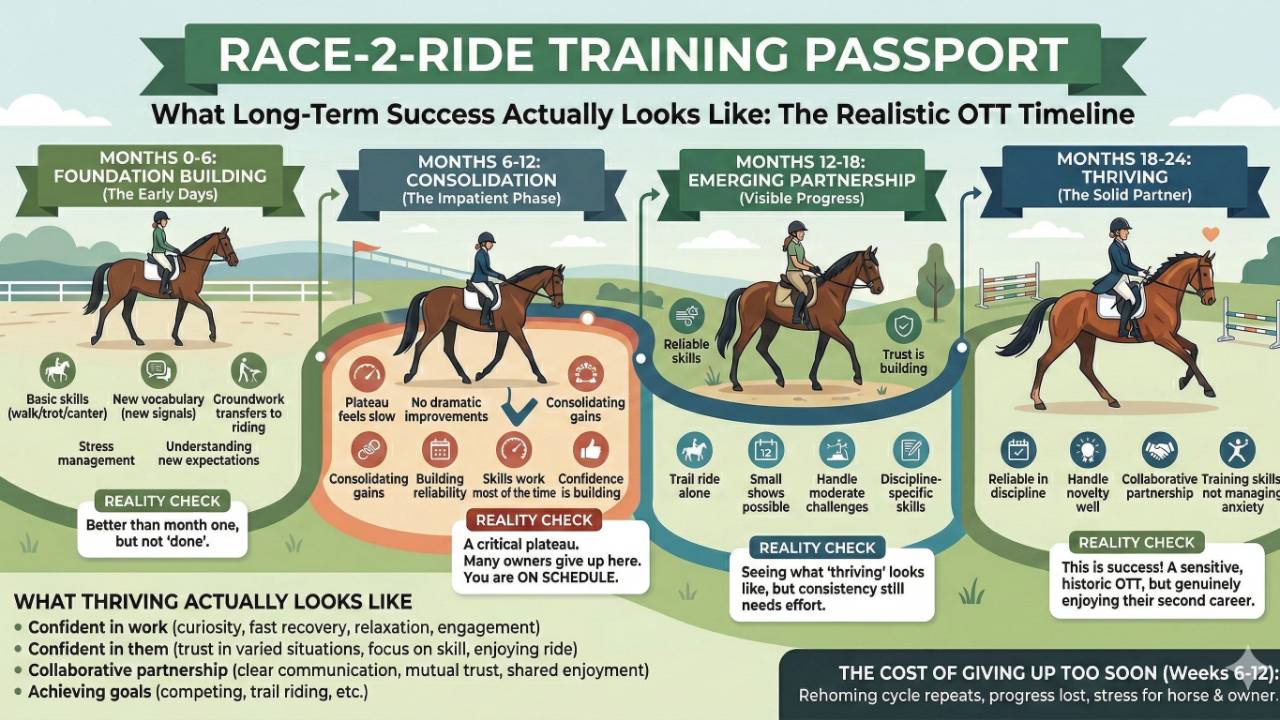
What Long-Term Success Actually Looks Like
There's a moment in every successful OTT journey where something shifts. You stop thinking, "I hope we survive this ride without incident." You start thinking, "I wonder what we could achieve together?"
That shift, from surviving to thriving, is the difference between managing a challenging horse and partnering with a confident, capable friend in their second career.
But here's what no one tells you: that transformation takes time. Longer than you want. Longer than social media suggests. Longer than well-meaning friends predict.
The realistic timeline for an OTT going from track retirement to genuinely thriving in a new discipline? Two years minimum. Often longer.
The Realistic Timeline
Months 0-6: Foundation Building
This is active retraining. You're teaching:
-
Basic skills (walk, trot, canter on new signals)
-
New vocabulary (signals mean different things than racing)
-
Stress management (downregulation skills)
-
Groundwork that transfers to riding
-
Understanding of new job expectations
Progress is visible but effortful. Good days alternate with challenging days. You're building the foundation that everything else rests on.
Reality check: You're still in early retraining. Things are better than month one, but you're not "done."
Months 6-12: Consolidation
This is where many people get impatient. Progress feels slow because you're no longer seeing dramatic daily improvements. Instead, you're consolidating gains and building reliability.
Skills that worked sometimes now work most of the time. Responses that required perfect conditions now work in a variety of situations. Your horse's confidence is building, but they still require careful management.
Reality check: This plateau phase is where many owners give up. They expect to be "finished" by now. They're actually right on schedule, but impatience leads to rehoming.
Months 12-18: Emerging Partnership
Something shifts around the one-year mark for most horses. The skills you've been building are starting to feel reliable. Your horse handles moderate challenges with increasing confidence. You trust them more. They trust you more.
You can do things that seemed impossible at month six: trail ride alone, attend small shows, work on discipline-specific skills, and handle unexpected situations calmly.
Reality check: You're starting to see what "thriving" looks like, but you're not there yet. Consistency still requires effort.
Months 18-24: Thriving
At around two years of consistent work, most OTTs have become genuinely solid partners. They're reliable in their discipline. They handle novelty well. The partnership feels collaborative rather than precarious.
You're not managing anxiety and reactivity anymore - you're actually training skills and achieving goals.
Reality check: This is what success looks like. Not perfect, still an OTT with sensitivity and history, but genuinely enjoying their second career.
Why the Timeline Matters
The six-month-to-one-year period is critical because it's when most owners quit. They expect to be thriving by six months, or at least by one year. When they're still in the consolidation phase, making progress but not "finished", they assume something is wrong.
"Maybe I'm not the right rider for this horse." "Maybe this horse has issues I can't fix." "Maybe I should have bought something quieter."
Usually, nothing is wrong. They're exactly where they should be in the timeline. But without understanding that months 6-12 are consolidation (not failure), they give up during the most critical phase.
What Thriving Actually Looks Like
Thriving doesn't mean your OTT acts like a horse who never raced. It means:
They're confident in their work:
-
Approach new challenges with curiosity rather than fear
-
Recover quickly from surprises
-
Show relaxation during and after work
-
Engage willingly rather than reluctantly
You're confident in them:
-
Trust them in varied situations
-
Focus on skill development, not anxiety management
-
Enjoy riding rather than dreading problems
-
Feel proud of your partnership
The partnership is collaborative:
-
Clear communication in both directions
-
Mutual trust and understanding
-
Problem-solving together
-
Shared enjoyment of activities
They're achieving goals:
-
Competing, trail riding, teaching, or whatever your goals are
-
Meeting challenges appropriate to their training level
-
Continuing to develop skills and confidence
-
Thriving in their chosen discipline
But, and this is important, they're still OTTs:
-
More sensitive than horses who never raced
-
Require thoughtful riding and management
-
Have preferences and limitations based on their history
-
Need consistency and clear communication
Thriving doesn't erase their past. It means they've successfully built a new career despite (and sometimes because of) their past.
What Enables Thriving vs. What Prevents It
Research on successful OTT retraining, combined with three decades of practical experience, reveals clear patterns:
Horses who thrive have owners with:
-
Realistic timelines Understanding that two years is normal, not excessive. Patience through the consolidation phase.
-
Evidence-based knowledge Training based on equitation science, not trends or tradition. Understanding why methods work, not just following steps.
-
Ongoing support Access to expertise when problems arise. A community of people who understand OTT-specific challenges. Resources that don't disappear after initial placement.
-
Systematic approach Clear progressions from foundation through advanced work. Not random tips applied inconsistently.
-
Commitment to the long game Staying through the challenging middle months. Prioritising the horse's welfare over convenience. Accepting that this is a multi-year investment.
Horses who don't thrive often have owners who:
-
Expected faster results (quit during the consolidation phase)
-
Used trial-and-error rather than systematic methods (created problems while trying to solve them)
-
Lacked ongoing support (gave up when stuck)
-
Compared their horse to unrealistic standards (constantly disappointed)
-
Weren't prepared for a multi-year commitment (rehomed prematurely)
The pattern is clear: thriving isn't primarily about the horse's potential. It's about whether the owner has the knowledge, support, and commitment to facilitate that potential.
The Cost of Giving Up Too Soon
When owners rehome during months 6-12 (the consolidation plateau), here's what typically happens:
For the horse:
-
Loses all progress built with the previous owner
-
Experiences stress of a new home and new handling
-
May develop trust issues from repeated rehoming
-
Gets further from thriving with each home change
-
Risks of ending up in unsuitable situations
For the new owner:
-
Receives incomplete or inaccurate information
-
Starts over without foundation knowledge
-
May hit the same challenges without support
-
Cycle potentially repeats
For the original owner:
-
Regret (often realises later they gave up during a normal plateau)
-
Loss of the partnership they were building toward
-
Reinforced belief they "can't handle" OTTs
For the industry:
-
Perpetuates a cycle of OTTs changing hands 3-4 times
-
Reinforces perception that OTTs are "difficult"
-
Prevents horses from reaching their potential
This cycle is why understanding the realistic timeline matters so much. When you know month 8 is supposed to feel slow, you don't interpret normal progress as failure.
What Success Stories Have in Common
Every successful OTT transformation I've witnessed in 30+ years shares these elements:
-
Patient owners who stayed They committed to a multi-year timeline and didn't quit during plateaus.
-
Systematic training They followed evidence-based progressions rather than random advice.
-
Support systems They had access to expertise, community, and resources.
-
Celebration of progress They measured success against past performance, not external standards.
-
Adaptability When one approach didn't work, they tried different methods (with guidance).
-
Investment in learning They continuously developed their own knowledge and skills.
-
Realistic expectations They accepted their horse's individuality rather than trying to force a template.
These factors are more predictive of thriving than the horse's racing record, conformation, breeding, or any other horse-side variable.
Key Takeaways
-
Realistic timeline is 2+ years from track to thriving, not 6 months
-
Months 6-12 are consolidation (slow progress is normal, not failure)
-
Thriving means confident partnership, not erasing OTT characteristics
-
Owners with support, knowledge, and commitment enable thriving
-
Most rehoming happens during normal plateau phases
-
Success is more about the owner's resources than the horse's potential
-
Celebrating progress against past (not external standards) maintains motivation
Your OTT can absolutely thrive in their second career. The question is whether you have the timeline understanding, support, and commitment to facilitate that transformation.
Surviving is managing problems. Thriving is achieving a partnership. The difference is time, knowledge, and support.
Ready to learn evidence-based methods for retraining your OTT through every stage of their journey? Join Race-2-Ride for lifetime support.