
Forward Without Frantic
Feb 21, 2026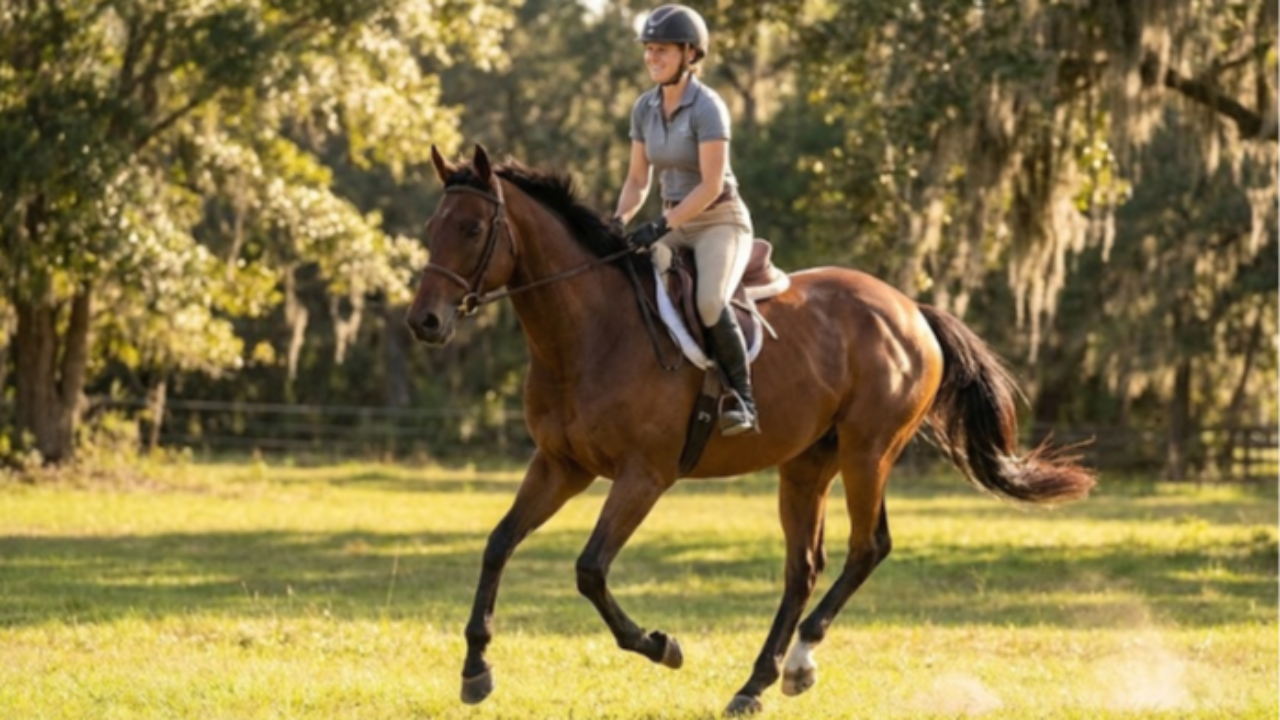
Creating Power and Impulsion Without Anxiety
Your OTT knows forward. They're brilliant at it. Years of racing taught them that forward equals speed, adrenaline, and maximum effort. What they don't know, what they've never experienced, is forward with relaxation.
You're asking for something completely foreign to their experience: energy without anxiety, impulsion without panic, power without losing their brain. This isn't a small request. You're teaching them an entirely new concept that directly contradicts years of conditioning.
But it's possible. It's actually one of the most rewarding transformations in OTT retraining - watching a horse discover they can access power while staying mentally and emotionally calm.
The Fundamental Problem: Rhythm vs. Speed
Most riders focus on controlling speed. "Don't go too fast!" This creates a confusing contradiction:
-
Leg says "go forward"
-
Hand says "slow down"
-
Horse experiences: conflicting pressures
The result is tension, anxiety, and confusion. Your horse is trying to simultaneously go forward and not go forward. This contradiction creates the hollow back, high head, and tense muscles you're trying to avoid.
Better approach: Establish rhythm first, adjust speed second.
Rhythm is the steady, consistent tempo of footfalls. Speed is how much ground is covered. These are different variables that can be adjusted independently.
A horse can have:
-
Fast rhythm, little speed (short, quick steps covering minimal ground)
-
Slow rhythm, high speed (powerful strides covering maximum ground)
-
Any combination in between
When you focus on rhythm rather than speed, you give your horse a clear boundary: "Maintain THIS tempo." This is concrete. Understandable. Trainable.
The Rhythm Rule in Practice
Step 1: Establish a countable rhythm
At walk, count out loud: "1-2, 1-2, 1-2" in a steady tempo. This is your target rhythm.
Use your voice to reinforce: "Walk-on, walk-on" at the exact tempo you want.
Your horse begins to associate the rhythm of your voice with the rhythm you want in their legs.
Step 2: Maintain rhythm with minimal signals
Light leg signals if the rhythm slows. Voice cue if the rhythm quickens. Release all signals, voice and leg when the rhythm is correct.
Your horse learns: "My job is to match this rhythm, not to guess what speed my rider wants."
Step 3: Add energy without changing tempo
Here's where it gets sophisticated. Ask for MORE POWER in each stride while maintaining the same tempo.
Count the same "1-2, 1-2" rhythm, but use a light leg to increase the energy each stride contains. The stride becomes longer and more powerful, but the rhythm stays consistent.
This is impulsion: power without speed. This is what you're building toward.
Why Contact Creates Anxiety at Forward Gaits
For many OTTs, forward gaits (especially canter) trigger anxiety because they're connected to racing memories. But contact at forward gaits creates even more anxiety because contact predicted speed changes in racing.
The combination—canter + contact—can trigger strong conditioned emotional responses: "Canter with contact means racing is about to happen. Adrenaline should be high. Speed is coming."
Your horse's nervous system responds before conscious thought: tension, hollow back, high head, resistance.
Reconditioning Contact at Forward Gaits
Phase 1: Forward gaits on loose rein (weeks)
Establish walk, trot, and canter on a loose rein. No contact. Use only voice and leg.
Build positive associations: "Canter is calm. Canter is sustainable. Canter doesn't mean panic."
Until your horse can canter calmly on loose rein for several minutes, don't add contact. This foundation is essential.
Phase 2: Brief contact, immediate release (weeks)
Pick up contact and ask for give to the bit for only 3-5 strides at the canter. Return to loose rein before anxiety builds.
Pair contact with the voice cue "steady" or "canter" (which they've learned means "maintain this gait").
Reward any softness with immediate release.
Phase 3: Building duration (months)
Extend light, minimal contact to 10 strides, then 15, then a half circle, then a full circle.
Any time anxiety appears (hollow back, head up, tension), return to a loose rein. You pushed the duration too far. Back up and build more slowly.
Phase 4: Light contact becomes connection (months to years)
Eventually, light contact at canter means "we're connected and calm together" rather than "speed is coming."
This transformation takes months of consistent work. There are no shortcuts.
The Trot Dilemma
Trot is often the most challenging gait for OTTs because it's the "in-between" gait. Not slow like walk, not the primary racing gait like canter/gallop. It's where anxiety often manifests as jigging, rushing, or breaking to canter.
Why trot is difficult:
In racing, trot was primarily a warm-up gait or a transition phase - never a sustained working gait. Your horse has limited positive associations with sustained trot work.
Additionally, trot is bouncy. For anxious horses, the bouncing can increase arousal. They want to move into smoother gaits (walk or canter) to reduce the stimulus.
Building sustainable trot:
Stage 1: Very short duration (3-5 strides)
Ask for trot. Count rhythm. After 3-5 strides, return to walk BEFORE your horse gets anxious.
Repeat multiple times. End while the horse is still calm.
You're teaching: "Trot is short and calm, not sustained and anxious."
Stage 2: Gradually extend duration
Build to 10 strides, then 15, then 20, then a half circle, then a full circle.
If anxiety appears, reduce duration. You extended too quickly.
Stage 3: Add energy while maintaining rhythm
Once a sustainable trot is established, ask for more power in each stride while counting the same rhythm.
Bigger stride, same tempo. This is working trot - energetic but calm.
The Voice as Rhythm Anchor
Your voice is your most valuable tool when building forward without frustration because it can provide rhythm when body aids are being redefined.
Effective voice use:
-
Consistency: "Walk" always means walk at this specific rhythm
-
Timing: Voice cue before body/pressure signal (predicts what's coming)
-
Tone: Calm and steady, never harsh or excited
-
Rhythm: Voice matches the footfall rhythm you want
-
Fading: Gradually reduce voice as the horse understands body signals in a new context
Your voice becomes the metronome. When your horse hears "can-ter, can-ter, can-ter" at a specific rhythm, they begin to match that rhythm rather than defaulting to racing speed.
Over time, your horse will learn self-carriage and maintain rhythm. But during retraining, your voice is helpful.
Managing the "Frantic" Moment
Despite careful training, moments of rushing or anxiety will appear. How you handle these moments determines whether they become patterns or isolated incidents.
When the horse starts to rush:
DON'T:
-
Pull hard on reins (creates fight and resistance)
-
Get tense and match their energy (confirms they should be anxious)
-
Punish/correct the anxiety (increases anxiety)
-
Push through at a rushed pace (reinforces rushing)
DO:
-
Use voice to anchor rhythm: "Walk, walk, walk" or "Can-ter, can-ter, can-ter"
-
Sit deeper and slower in your seat (your body provides rhythm)
-
Half-halt with your entire body, not just your hands
-
If they don't settle in 3-4 strides, return to walk
-
Take a breath, let them settle, try again
You're teaching: "When you rush, we go back to easy. When you're calm, we can continue."
Common Mistakes in Developing Forward
Mistake 1: Prioritising speed over rhythm
Asking for "more forward" without defining what rhythm you want creates anxiety. The horse doesn't know if you want a faster tempo or a bigger stride.
Mistake 2: Adding contact too early
Trying to create forward motion with contact or in a frame before the horse can be forward without contact leads to anxiety.
Mistake 3: Drilling the difficult gait
If your horse struggles with canter, cantering for 20 minutes, hoping they'll settle, creates the opposite - increased anxiety and association of canter with stress.
Mistake 4: Inconsistent criteria
One day accepting jigging, the next day punishing it. A horse can't learn appropriate forward if the criteria keep changing.
Mistake 5: Comparing to non-OTT horses
Your friend's quiet warmblood can canter for 30 minutes on the first ride. Your OTT needs months to build to 5 minutes of calm canter. Different horses, different timelines.
Key Takeaways
-
Rhythm and speed are different variables - focus on rhythm first
-
Voice provides a rhythm anchor when body signals are being redefined
-
Light contact at forward gaits requires months of systematic reconditioning
-
Trot is often the most challenging gait due to limited positive associations
-
Short durations of calm forward beat long durations of anxious forward
-
Managing "frantic" moments teaches your horse how to self-regulate
-
Timeline is months to years, not weeks
Building forward without frantic is technical work requiring patience, consistency, and a deep understanding of how racing conditions your horse's responses to forward gaits.
But the transformation, watching your horse discover they can be powerful AND calm, is one of the most rewarding aspects of OTT retraining.