Reading Your Horse's Stress Signals
Feb 14, 2026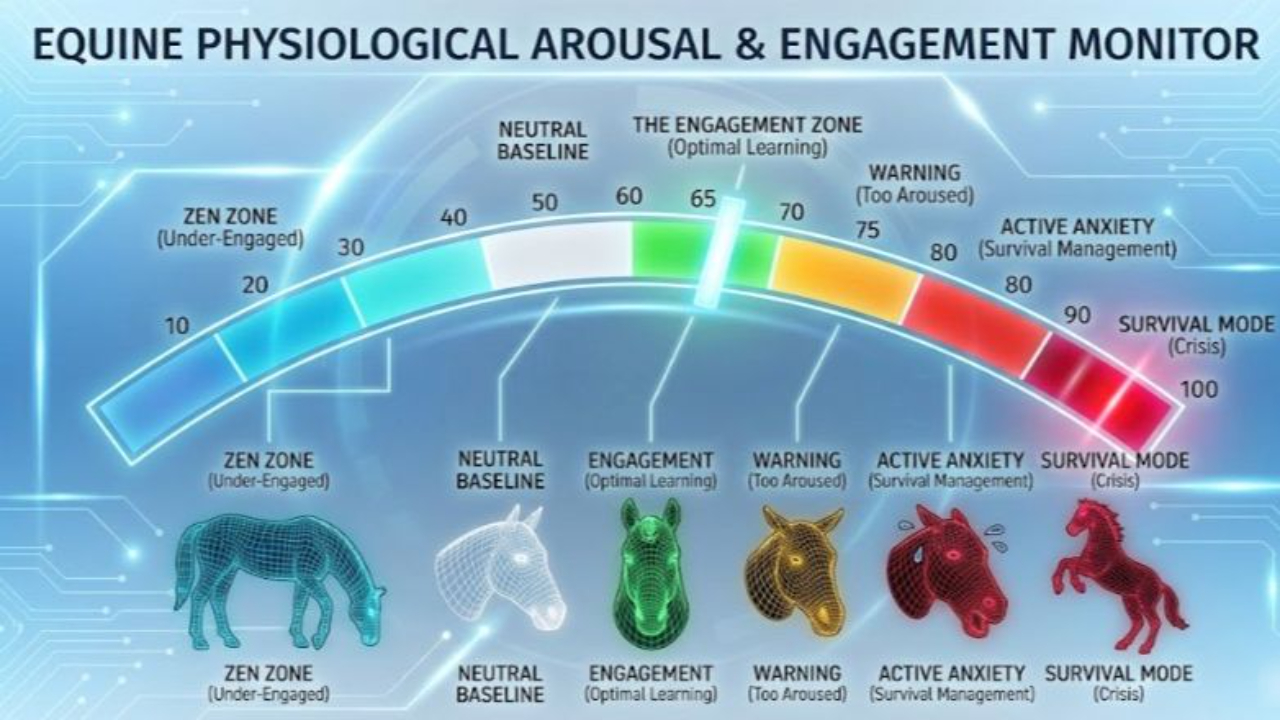
It’s a common misconception in the equestrian world that the "safest" riders are the ones with nerves of steel. In reality, the safest riders are the ones who are the best at reading their horses. They don't wait for a 100/100 explosion; they catch the tension when it’s still a subtle 70.
Your horse is constantly broadcasting their internal state through body language, breathing, and muscle tone. The question isn’t whether they are talking to you; it’s whether you’re tuned to the right frequency.
The 10–100 Stress Scale: Finding the Sweet Spot
Think of your horse's emotional state on a continuum. Understanding where they sit on this scale is the difference between a productive session and a dangerous one.
10–40: Under-Engaged (The "Zen" Zone)
At this level, the horse is completely relaxed - perhaps too much for active learning.
-
Physical Signs: Ears are mobile and soft; eyes may be half-closed.
-
Body: Breathing is slow, the lower lip may be loose, and they may cock a hip.
-
Learning Status: While this is a great reference point for your horse's "baseline," they aren't engaged enough for skill development.
50: The Neutral Baseline
This is your horse's "ready" state. They are awake and aware but have no significant tension or specific focus yet. It is vital to know what this looks like for your specific horse, as every horse has a unique baseline.
60–65: The Engagement Zone (The Sweet Spot)
This is where the magic happens for your training.
-
Physical Signs: Ears are more frequently locked on a point of interest, and muscles begin to "tone" rather than being floppy.
-
Body: Breathing increases slightly, and the eye is focused and open.
-
Learning Status: This is the optimal window for training. The nervous system is engaged but not overwhelmed, allowing the horse to think, process, and learn new skills.
70–75: The Warning Zone (Too Aroused)
Once you cross 65, your horse is moving out of the "thinking brain" and into the "survival brain".
-
Physical Signs: Ears may lock forward or pin back; the head may raise above its natural carriage.
-
Body: You may notice teeth grinding, breath holding, a tight jaw, or a tail that is swishing or clamped. They may begin to break gait or seem unable to bend.
-
Intervention: Stop here. Do not "push through". Make the task easier or change the environment to bring them back down to the 60 range.
80–90: Active Anxiety
At this level, training has effectively ended; you are now in "survival management".
-
Physical Signs: The horse may snort repeatedly, sweat in cool weather, raise their head high and hollow their back.
-
Body: They may ignore familiar signals and actively look for escape routes.
-
Learning Status: Research shows that at this level of arousal, stress hormones shut down the prefrontal cortex. The horse is physically incapable of effective learning.
100: Survival Mode (The Crisis)
This is the "explosion" many riders think of as unpredictable behaviour, but it’s actually the end of a long chain of ignored signals.
-
Signs: Bolting, rearing, or a complete mental "shutdown".
-
Status: The horse is operating on pure instinct, with no conscious thought. This state is dangerous for both the horse and the rider or handler.
Why "Pushing Through" is a Myth
One of the most damaging pieces of advice in the horse world is to "just push through" high-level stress. When you force a horse to work at 80/100 or higher, you aren't teaching them to be brave; you are teaching them one of two things:
-
Learned Helplessness: The horse realises their signals don't matter and shuts down. They might look "calm" outwardly, but they are internally struggling with chronic anxiety.
-
The 0-to-100 Pattern: If a horse learns that subtle signals (the high 60s and 70s) are ignored, they will eventually stop using them and jump straight to an explosion (85+) to be heard.
Key Takeaway: Training happens in the 60–65 range. Survival happens at 80+. If you learn to read the 60s, you will rarely ever have to deal with the high 80s .
How to Build Your "Stress Literacy"
Reading these levels is a skill that requires practice, not just "intuition".
-
Establish a Baseline: Spend 5 minutes observing your horse at rest. Count their breaths and note their "soft" eye expression.
-
The 5-Minute Check-In: While riding, ask yourself every few minutes: "Is the muscle tone tighter than it was 2 minutes ago? Are the ears locked?" "Is his/her head higher than before?"
-
Review the Tape: Film your sessions. You will often see "Level 70" signals on video that you completely missed while in the saddle.
Ready to learn evidence-based methods for retraining your OTT through every stage of their journey? Join Race-2-Ride for lifetime support.