When the Playbook Fails
Jun 26, 2026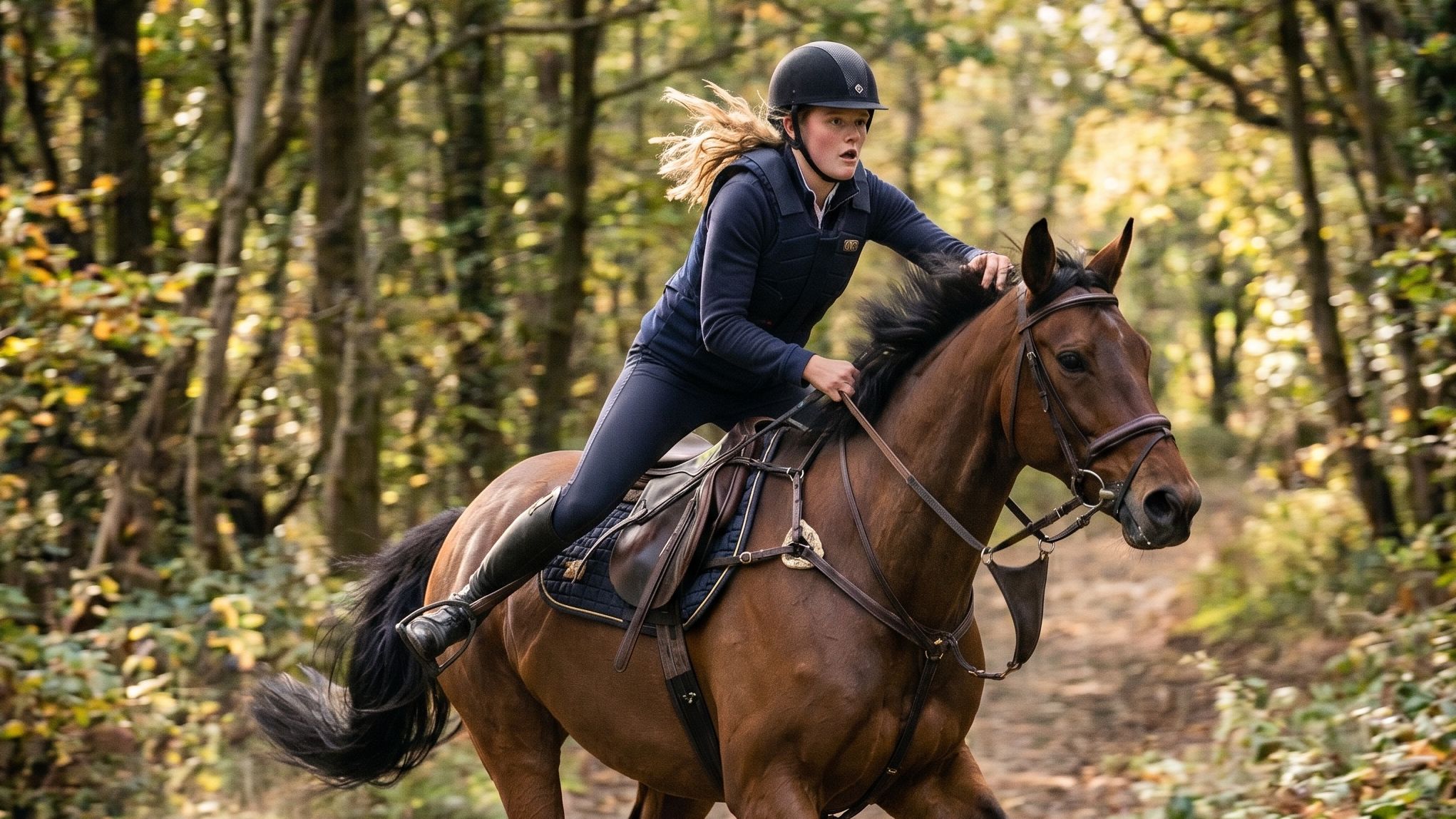
Rebuilding Independence in Your Off-The-Track Horse
Imagine this scenario: You are at a local clinic or event with your off-the-track horse (OTT). They have been working beautifully at home, but the atmosphere here is buzzing. Floats are arriving, other horses are calling out, and a Thoroughbred in a neighbouring stable is anxiously banging against the walls.
You saddle up, finish a riding session, and decide to let your horse cool down. You drop the reins to give them a well-deserved break, letting them walk quietly on a loose rein. Then, in a split second, your horse tenses, leaps forward, and careens down the laneway at a blind gallop, entirely checked out from your world.
It is a terrifying experience, but it is an incredibly common stopping point for OTT owners. When an ex-racehorse bolts or enters a state of blind panic, it is easy to assume they are unpredictable or unsafe.
But if we look at this through the lens of equine behaviour science and track conditioning, the horse didn't fail on purpose. The old racetrack playbook took over because they suddenly felt completely isolated in a high-arousal environment.
The Busy Environment: A High-Vigilance Trigger
To successfully transition an OTT into a calm riding horse, we have to understand what a busy event environment represents to them. For a horse conditioned to the track, a high-stimulus atmosphere, loud noises, banging partitions, shouting, and intense horse movement are the ultimate cues for peak adrenaline. It triggers a state of high vigilance, akin to an environmental trauma response.
Furthermore, racehorses are rarely independent. Throughout their racing careers, they are handled, exercised, and stable-managed alongside companion ponies or strings of other horses. They rely heavily on the herd to steady their nerves.
When you take an OTT into a new environment alone, and they witness another horse expressing extreme anxiety (like stable-banging), their emotional scale instantly spikes. They do not have the baseline independence to process that stress on their own.
The Loose Rein Trap: The Illusion of Relaxation
As riding horse owners, we view a long, loose rein as the ultimate reward and a sign of relaxation. We finish a test or a training session, loop the reins over the horse's neck, and check out mentally.
But for an anxious, high-vigilance OTT, a loose rein can accidentally feel like abandonment.
If a horse’s emotional level is steadily climbing toward the danger zone, dropping the contact entirely breaks your line of communication. You have effectively stepped out of the bubble. Finding themselves alone in their minds in a frightening environment, the horses' natural flight instinct takes full control. Because they don't know the rules of a loose rein, they panic.
True welfare means understanding that you cannot force a horse to relax by simply giving them a loose rein. But if you offer the opportunity for a loose rein only if their poll remains below their withers, they quickly work out that loose rein equates with relaxation. The moment that the head elevates, it is a clear warning sign that their emotional level has spiked. You then pick up the reins, recreate the communication bubble, and give them a job.
Tracking the Scale and Rebuilding Independence
Rebuilding an OTT’s confidence in a busy environment requires you to map out their emotional level on a scale from 0 to 100 (where 50 is total relaxation).
When you notice your horse creeping from a manageable 60 up to a tense 70, you cannot just sit there and watch it happen. You must actively engage their brain before they hit a blind, galloping 90.
Bring them back into your bubble by asking clear, highly familiar behavioural questions. Ask them to give to the bit, flex their poll, or yield their shoulders. Use combined reinforcement: an immediate release of pressure the millisecond they make a soft attempt, followed by a physical scratch on the withers.
This interaction acts as a neurophysical grounding technique. It proves to the horse that even though the world outside is chaotic, the rules inside your communication bubble are completely predictable, safe, and rewarding.
Re-Training the Stop: Moving Beyond Emergency Brakes
When a horse bolts at a flat-out gallop, relying on an untrained emergency manoeuvre like a violent one-rein stop is incredibly dangerous. At high speeds, forcing a horse’s head around can cause them to lose footing, spin dangerously, or flip over.
We must replace panic-driven emergency handles with an educated behavioural response. Re-training the stop means breaking the cue down to its absolute simplest form on the ground first, ensuring the horse understands how to halt from a whisper of a signal, before testing it under saddle in challenging environments. Re-educating an OTT isn't about controlling their body through physical force; it's about controlling their mind through absolute predictability.
Step Into the Science: The Race-2-Ride Pilot Study
Transitioning an off-the-track horse through environmental anxiety and building true, confident independence requires a step-by-step, scientifically validated framework. You don’t have to navigate these overwhelming moments by guesswork or luck.
Our university ethics-approved Race-2-Ride platform is designed specifically to help OTT owners track behavioural data, identify micro-signals of stress, and implement structured milestone training to safely rewrite track conditioning. We are currently accepting dedicated owners into our official research pilot study. By joining, you gain the exact digital curriculum and expert community support needed to turn environmental triggers into opportunities for calm, harmonious connection.
Ready to build a truly safe, independent partnership under saddle? Click here to learn more about the Race-2-Ride Pilot Study and apply for our official cohort today.