The Retraining Gaps No One Talks About
Mar 07, 2026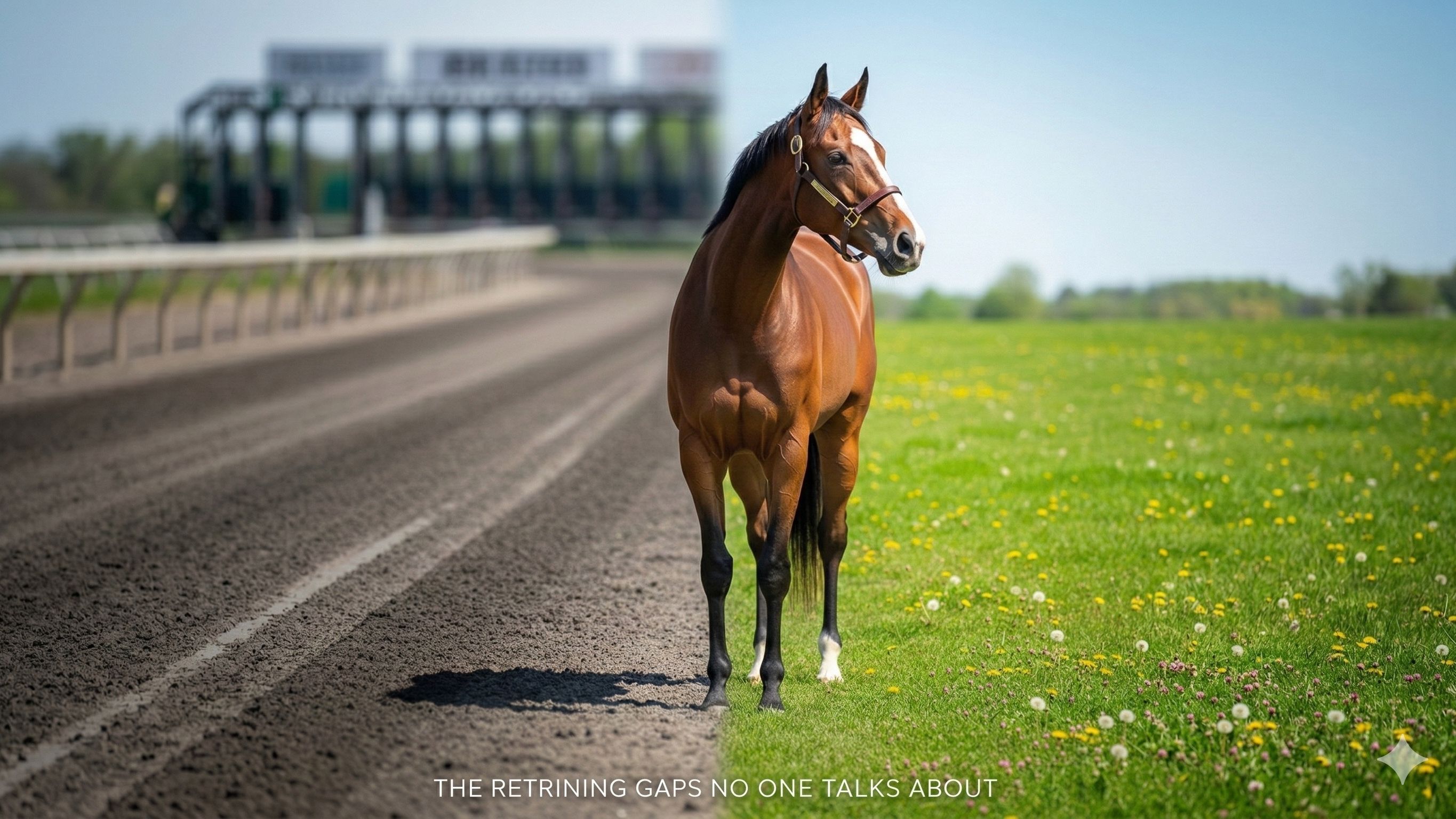
The Welfare Crisis Hiding in Plain Sight
Here are some statistics that should shock you:
Key Statistics from Racing Integrity Commission industry review (2023–2025)
While many horses are "repurposed," there is a distinct gap between those sold privately and those entering the state-sanctioned Queensland Off-The-Track (QOTT) Acknowledged Retrainers Program.
- Total Retirements: In the 2023/24 financial year, 3,321 Thoroughbreds and 276 Standardbreds were officially retired in Queensland.
- Official Retraining Rate: Data indicates that between January 2022 and June 2024, only 179 Thoroughbreds and 46 Standardbreds were rehomed specifically through the QOTT Acknowledged Retrainers Program.
- The Percentage: This suggests that approximately 3% to 5% of newly retired racehorses in Queensland transition through the official professional retraining network.
Now here's the statistic no one talks about: five years later, most of those same horses have changed hands two to three times and are completely disconnected from any support system.
Even the limited initial support that set them up for success is gone. Most retiring racehorses get no professional guidance to help their first owner. Further, there is nothing at all available to subsequent owners. Any welfare oversight that ensured proper placement ended after the first home.
This is the retraining gap - and it's a welfare crisis hiding in plain sight.
Mapping the Journey: Where Support Disappears
Year 0-1: The Supported Phase (this can work very well)
When racehorses retire, many jurisdictions have excellent programs:
-
Professional retraining facilities
-
Veterinary care and rehabilitation
-
Adoption screening and education
-
Follow up with adopters
-
Ongoing support during the transition period
-
Welfare checks and accountability
Some first adopters receive education, support, and resources. When it happens, this phase works.
But then something happens that the statistics don't capture.
Year 2-3: The First Gap Appears
Life changes for that first owner:
-
Financial circumstances shift (job loss, unexpected expenses)
-
Health issues arise (injury, illness, ageing)
-
Life transitions happen (moving, family changes, career demands)
-
Training challenges emerge that they can't solve
-
Horse develops issues requiring expertise they don't have
Here's the critical point: these owners aren't bad owners. They're often committed, caring people who face circumstances or challenges beyond their capacity.
Without ongoing support, they struggle because the original program has moved on to the next cohort of retiring horses. They try to solve problems alone. They search for help but find conflicting advice. Eventually, they make the difficult decision to rehome.
The new owner receives:
-
Race name and possibly current name
-
Basic information (age, maybe some history)
-
Vague assurances ("great horse, just need to downsize")
-
Zero connection to the original training program
-
No detailed training records
-
No ongoing access to expert support
The gap has appeared.
Year 4-8: The Widening Gap
That second owner now faces their own challenges; different challenges, but equally real. They have even less support than the first owner because they're completely disconnected from any official program.
When they struggle, they have:
-
Google and YouTube (conflicting information)
-
Facebook groups (well-meaning but often incorrect advice)
-
Local trainers (who may not specialise in OTTs)
-
Trial and error (inefficient and potentially harmful)
What they don't have:
-
Access to the expertise that supported the first placement, if they had one
-
Detailed history of what training approaches worked or failed
-
Understanding of the horse's specific needs and triggers
-
A community of people retraining the same types of horses
-
Welfare oversight or intervention when needed
Eventually, many of these second owners also rehome. The pattern repeats.
Year 10-30: The Crisis
By year ten, many OTTs are in their fourth or fifth home. Each transition has moved them further from support:
-
Training history is lost or distorted
-
Problems may have compounded through inconsistent handling
-
Some develop learned helplessness from repeated rehoming
-
Others become labelled "difficult" when they're actually confused
-
Risk increases for ending up in unsuitable situations
-
Some fall through cracks entirely - sold cheaply, neglected, or worse
This is the welfare crisis: horses who received initial support are now completely lost in the system.
Why This Gap Exists: It's Systemic, Not Individual Failure
This isn't about bad programs or bad owners. It's about a systemic gap that emerges from how we currently structure OTT support:
Gap 1: Programs Focus on Placement, Not Lifetime Support
Retraining programs measure success by "horses successfully placed." This is appropriate; they can't support every horse for 30 years with current resources.
But it means support ends after successful placement. The expertise, resources, and infrastructure remain with the program, not with the horse.
Gap 2: No Portable Training Records
When horses change hands, their detailed training history disappears. There's no standardised system for:
-
Recording what training methods were used
-
Documenting challenges and solutions
-
Tracking health and behaviour history comprehensively
-
Passing complete information to new owners
-
Maintaining continuity across ownership changes
Each new owner starts essentially blind.
Gap 3: Subsequent Owners Have No Access to Expertise
The first adopter got expert support from the placement program. Subsequent owners get Google.
This creates dramatic inequality: one owner has professional guidance, the next has trial-and-error.
Gap 4: Community Connection Disappears
OTT owners benefit enormously from community - people who understand these specific horses and challenges. But when ownership changes, that community connection is lost.
New owners can feel isolated unless they happen to find informal networks.
Gap 5: No Ongoing Welfare Oversight
After initial placement, there's typically no systematic welfare monitoring. If the horse ends up in a second, third, or fourth home, no one checks on its well-being or intervenes if problems arise.
The 34% No One Discusses
Here's another number that matters: approximately 34% of horses registered for racing never actually race. They're named, they go through some training, but they never compete.
Yet they're still Thoroughbreds who end up in homes. They need retraining support too, but because they never "retired from racing" or perhaps were domiciled in another state, they often fall completely outside existing support systems.
These horses disappear into the system with zero support from day one.
The Welfare Mathematics
Let's do the math on what this gap means:
Each year in Australia, approximately 8,500 to 11,000 Thoroughbred racehorses retire from the industry. When including Standardbreds (harness racing), the total number of retired racehorses nationally is estimated to be between 11,000 and 14,000 annually.
The most recent industry data and independent research (such as the Thoroughbred Aftercare Welfare Working Group and academic studies from the University of Melbourne) break down the annual numbers and destinations as follows:
Thoroughbred Retirement Statistics
Of the roughly 35,000 Thoroughbreds in training across Australia at any given time, about 17% to 20% exit the racing population each year.
Total Retirements: ~8,500–10,000 horses per year.
Median Age at Retirement: 5 years old.
Primary Destinations:
Equestrian & Pleasure Riding: ~45% – 50% (approx. 4,500 horses).
Thoroughbred Breeding: ~30% (approx. 2,700 horses, mostly mares).
Companionship/Pet: ~8% – 10%.
Livestock/Working Horses: ~4% – 5%.
Standardbred Retirement Statistics
Standardbreds (harness racers) have a slightly different retirement profile, often characterised by high rehoming rates due to their hardy temperament.
Total Retirements: ~2,500–3,000 horses per year.
Rehoming Rate: Approximately 70% to 80% of retired Standardbreds are rehomed into equestrian or pleasure roles through programs like SPPHRA (Standardbred Pleasure and Performance Horse Association).
The "Unraced" Population
It is important to note that a significant number of horses are "retired" before they ever reach the track. Industry estimates suggest that for every 100 foals born, only about 70% eventually make it to an official trial or race. This adds several thousand "unraced" horses to the annual pool of horses seeking second careers.
While approximately 11,000 to 14,000 racehorses (Thoroughbred and Standardbred) retire across Australia each year, the level of "support" they receive varies drastically depending on how you define it.
There is a significant gap between horses entering an official industry retraining pipeline and those simply having access to post-retirement incentives.
1. The "Official" Retraining Pipeline (2% – 5%)
Direct, hands-on professional retraining managed or funded by state racing authorities (PRAs) is the most intensive form of support, but it reaches the smallest percentage of horses.
National Estimate: Industry reviews (including the TAWWG "The Most Important Participant" report) indicate that only about 2% to 5% of retiring horses enter official PRA-overseen retraining or rehoming schemes.
Queensland Context: As we discussed, between 2022 and 2024, only about 4% of Queensland's retired racehorses moved through the QOTT Acknowledged Retrainers Program.
Victoria's RESET Program: Specifically targets "high-risk" horses that struggle to transition. While vital, it handles hundreds, not thousands, of horses annually.
2. Post-Transition "Incentive" Support (20% – 40%)
A much larger group of horses receives "support" in the form of subsidised lessons, event sponsorships, or clinic access once they are already in their new homes.
WA (OTTWA): Their registry (the OTTWA Passport) has over 4,500 horses, with roughly 1,000 horses receiving support through sponsorships and clinics in 2024 alone.
NSW (Equimillion): Over 500 horses competed in this $1 million incentive event in late 2024. Racing NSW also reports conducting over 5,000 physical welfare inspections of rehomed horses to date.
Queensland (QOTT): The Subsidised Lessons Program is the primary "support" mechanism here, providing vouchers to hundreds of new owners annually, though many owners remain unaware of their eligibility.
3. The "Accountability Gap" (50% – 60%)
The majority of horses retire via private sale or transfer (often referred to as "repurposing").
The Reality: While ~90% of horses are reported as "repurposed" into breeding or equestrian roles, about half of all retirements receive zero formal industry support or tracking after the initial "Notification of Retirement" is lodged.
Traceability: This remains the biggest hurdle for equitation science and welfare advocacy—once a horse is sold privately, the industry "support" usually ends unless the new owner proactively joins a state program like the QOTT Clubhouse.
| Level of Support | Reach (Est.) | Examples |
| Full Retraining | <5% | QOTT Acknowledged Retrainers, RV RESET Program. |
| Financial/Educational | ~25% | Subsidised lesson vouchers, OTT clinics, and welfare grants. |
| Event-Based | ~10% | Equimillion (NSW), OTT Show Series, High-Point awards. |
| Private/Independent | ~60% | Private sales, breeder retention (no official support). |
By year five? We really don't know 😢
What Happens in the Gap: Real Outcomes
Best case scenario: Horse gets lucky with knowledgeable, committed subsequent owners who figure things out despite a lack of support. The horse eventually thrives, but takes longer than necessary and faces unnecessary setbacks.
Common scenario: Horse changes hands 3-4 times in the first decade post-racing. Each owner tries their best but lacks support. The horse develops issues from inconsistent training. Eventually labelled "difficult" when they're actually confused and anxious from repeated disruption.
Worst-case scenario: Horse cycles through increasingly unsuitable homes as price drops and history becomes more concerning. May end up neglected, in dangerous situations, or meet a premature end.
All of these outcomes share one thing: they're preventable with lifetime support.
The Solution Framework: What Closing This Gap Requires
Closing the retraining gap requires infrastructure that doesn't currently exist at scale:
Component 1: Training Passport That Travels With Horse
Digital system that includes:
-
What methods work, what doesn't
-
Challenges and solutions discovered
-
Supportive community and access to advice
When a horse changes hands, the passport transfers.
Component 2: Lifetime Access to Expert Training
Educational resources that belong to the HORSE, not the owner:
-
Evidence-based training modules
-
Progressive skill development
-
Problem-solving protocols
-
Discipline-specific guidance
Every owner, first, second, and fifth, has access to the same expert guidance.
Component 3: Persistent Community Support
Community that isn't tied to initial placement:
-
OTT owners across all stages
-
Expert moderation and guidance
-
Problem-solving support
-
Celebrating successes
-
Accountability and encouragement
New owners can immediately access this community regardless of where they got their horse.
Component 4: Attachment at Registration, Not Retirement
For this to work, support must attach when horses are REGISTERED with the studbook, not when they retire.
Why? Because:
-
34% of registered horses never race but still need support
-
Attaching at registration means it travels from day one
-
Never gets "lost" because it's there from the beginning
-
The passport acts as the horses' superannuation
Component 5: Belongs to Horse, Not Owner
The passport and access must belong to THE HORSE.
When ownership changes:
-
The new owner can claim access using the horse's registration details
-
Automatic transfer of all training and support
-
Ensures support continuity regardless of ownership changes
-
Horse NEVER loses support, no matter how many homes
Why This Matters: The Welfare Impact
Imagine the same scenario with lifetime support:
Year 2-3: First owner hits challenges. Instead of struggling alone, they access relevant training modules. They post in the community. They get expert guidance. Many problems are solved. Horse stays.
IF rehoming is necessary: Complete training package transfers. Second owner gets full training modules, ongoing access to the same modules, and immediate community support. They're not starting blind.
Year 5-10: If the horse changes hands again, the pattern continues. The third owner has everything the second owner had. Fourth owner too.
Result: Dramatically fewer ownership changes (more problems solved means fewer rehomings). When rehoming happens, much better outcomes (complete information plus ongoing support).
Horses never fall through the gap because the support travels WITH them.
The Current Cost vs. The Solution Cost
Current system costs:
-
Professional retraining for initial placement: $5,000-15,000 per horse
-
That investment benefits only the first owner
-
Subsequent owners receive zero support despite the horse's initial professional start
-
Problems compound, welfare suffers, horses cycle through homes
Lifetime passport system costs:
-
One-time enrollment (much less than initial professional training)
-
Supports the horse for the entire 20-30-year post-racing life
-
Benefits every owner the horse ever has
-
Prevents problems rather than requiring expensive remediation
-
Improves welfare across the entire lifetime
The mathematics are compelling: investing in lifetime support prevents the financial and welfare costs of horses falling through gaps.
Key Takeaways
-
Current programs provide some excellent initial support, but can't support 30-year lifespans
-
The support gap appears after the first placement when horses change hands
-
Subsequent owners receive little to no support despite the horse's professional start
-
Gap affects thousands of horses annually as they cycle through homes
-
Systemic problem requires systemic solution, not individual effort
-
A lifetime passport that travels with the horse closes the gap
-
Support must attach at registration and belong to the horse, not the owner
-
Investment in lifetime support prevents compounding welfare problems
The gap exists. We've mapped it. We understand why it happens. We know what closing it requires.
The question isn't whether we can close this gap. The question is whether we will.
Because right now, thousands of horses who received brilliant initial support are lost in a system that abandons them after the first placement. They deserve better. Their owners deserve better. The industry deserves better.
Ready to learn evidence-based methods for retraining your OTT through every stage of their journey? Join Race-2-Ride for lifetime support.