Why Going It Alone Is Harder
Mar 14, 2026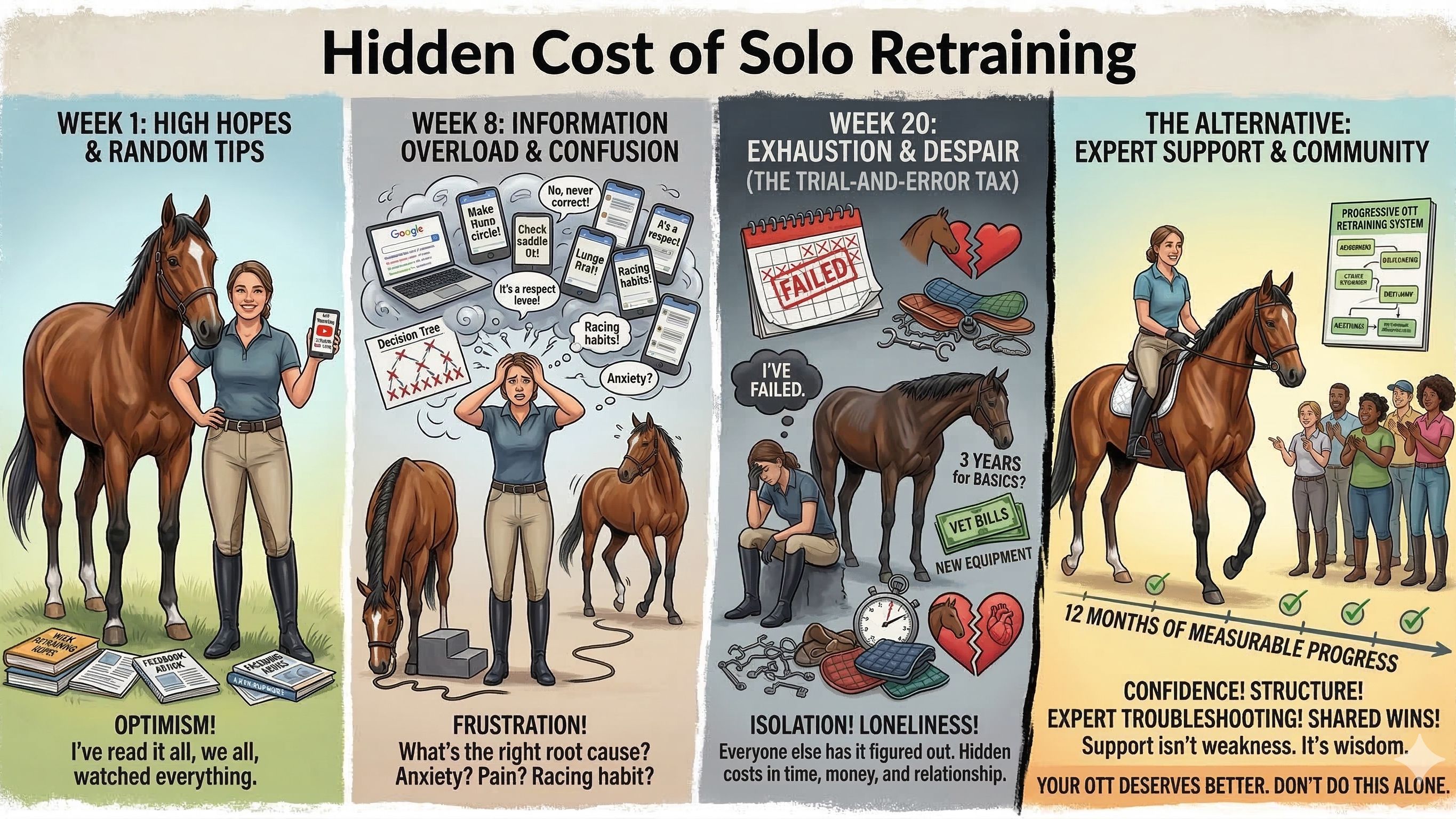
The Hidden Cost of Solo Retraining
You're doing everything right. You've watched every YouTube video. You've read the books. You've asked questions in Facebook groups. You've taken lessons when you can afford them. You're trying so hard.
And yet you still feel alone. Confused. Like everyone else has figured this out except you.
Here's what I need you to understand: retraining an OTT alone IS harder. Not because you're incapable. Not because your horse is "too difficult." But because you're trying to solve genuinely complex problems with incomplete, conflicting, and often incorrect information.
This isn't a personal failure. It's a predictable outcome of attempting sophisticated work without adequate support.
The Information Overload Problem
Let's walk through what "doing research" actually looks like for most OTT owners:
Your horse won't stand still at the mounting block. So you Google it.
Result: Twenty different answers from twenty different sources:
-
"Make them circle if they move, they'll learn standing is easier"
-
"Never correct/punish at the mounting block, just mount from wherever they stop"
-
"It's a respect issue; make them back up 10 steps each time"
-
"Practice dismounting and mounting repeatedly until they're bored"
-
"Lunge them first, so they're too tired to move"
-
"Check saddle fit, it's probably pain"
-
"My horse did that, I just got on anyway and they got over it"
-
"Teach them to ground tie first"
Which one is right?
The honest answer: Maybe all of them. Maybe none of them. It depends entirely on WHY your horse won't stand.
Is it:
-
Anxiety (standing feels vulnerable to racing-conditioned brain)?
-
Pain (saddle pinches, back is sore, mounting hurts)?
-
Lack of training (never learned that standing is expected)?
-
Racing habits (in racing, mounting = immediate movement)?
-
Confusion (unclear what you're actually asking)?
Different root causes require completely different solutions.
The mounting block issue caused by anxiety requires nervous system work and gradual desensitisation. The same issue caused by pain requires veterinary intervention and saddle fitting. The issue caused by racing habits requires systematic reconditioning.
Using the anxiety solution for a pain problem makes things worse. Using the reconditioning solution for an anxiety problem creates more anxiety.
Random internet advice doesn't help you diagnose. It just gives you tactics. And if you choose the wrong tactic for your specific cause, you waste months and potentially create new problems.
What You Actually Need:
-
Assessment framework - How do I identify the actual cause?
-
Decision tree - If cause is X, then solution is Y
-
Progressive plan - Step 1, then step 2, then step 3...
-
Troubleshooting guide - If that doesn't work, here's why and what to try next
-
Expert feedback - When you're stuck, someone who can see what you're missing
That's systematic training. Random tips from Google can't provide this.
The Emotional Toll No One Talks About
Let me tell you what happens emotionally when you're retraining an OTT completely alone:
Week 1: Excitement! You have your horse. You've found some advice. You have a plan. You're going to figure this out.
Week 4: Harder than expected, but you're trying different approaches based on what you've read. Surely something will work.
Week 8: Frustration building. You've tried ten different things. Some helped a little. Some made it worse. Nothing's really working consistently.
Week 12: Exhaustion. Your horse seems confused. You're no longer sure what's working and what isn't. You're questioning every decision.
Week 16: Loneliness. Everyone on Instagram seems to have it figured out. Their horses are progressing. Yours is still struggling with the basics. You must be doing something wrong.
Week 20: Despair. Maybe you're not the right person for this horse. Maybe you should rehome them to someone more experienced. Maybe you've failed.
I watch this pattern repeat over and over. Committed, caring owners who are trying incredibly hard to reach week 20 and give up - not because they can't do it, but because they're attempting genuinely complex work without support.
Now imagine if instead:
Week 4: You hit a challenge. You check the relevant training module for that specific issue. Clear answer based on the assessment framework. You know what to do.
Week 8: Still struggling with one aspect. You post in the community with specific details. Three experienced OTT owners and an expert respond within hours with targeted guidance.
Week 12: Horse is making measurable progress. You can track it against the benchmarks provided in the progressions. You know you're on the right path.
Week 16: You're not alone. You're part of a community celebrating each other's small wins. You see others at similar stages. You realise your progress is normal.
Week 20: You're proud of how far you've both come. You have a clear plan for continuing. You know where to get help when you need it.
The difference isn't your capability. It's your support system.
Why Expert Guidance Actually Matters
"Can't I just figure it out myself? I'm reasonably intelligent. My horse and I will work it out."
You can. People do. But here's what that looks like:
Self-taught approach:
-
3 years of trial and error
-
Creating 5 new problems while solving 2 original problems
-
Undoing damage from methods that seemed right but weren't
-
Frustration, confusion, and near-giving up multiple times
-
Eventually succeeding but taking 3x longer than necessary
Expert-guided approach:
-
12-18 months of systematic progression
-
Preventing most problems before they develop
-
When problems arise, knowing exactly how to troubleshoot
-
Clear milestones and measurable progress
-
Confidence throughout the process
Both routes can reach success. One is dramatically more efficient and less painful.
Let me give you a concrete example from my own experience:
The Case of the Anxious Canter
Years ago, I retrained a mare who became severely anxious at canter, hollow back, tension, and sometimes bucking. If I'd been working alone with just Google, I might have tried:
-
Lunging her tired first (doesn't address the root cause)
-
Different saddle (wasn't the issue in this case)
-
Stronger riding (would have made it catastrophically worse)
-
"Just keep cantering until she settles" (would have created trauma)
But because I had expert training in equitation science, I knew to:
-
Rule out pain first: Vet check, saddle fit, back assessment ✓
-
Assess nervous system response: Is this anxiety or evasion? (Anxiety)
-
Identify trigger pattern: When does anxiety spike? (When I picked up contact at the canter)
-
Check training history: What does canter + contact mean to her? (In racing: rate speed for a sharp turn)
Root cause discovered: Her nervous system associated contact at canter with "prepare for high-speed turn - danger possible."
Solution: Not what random internet advice would suggest. It was:
-
Weeks of canter on a completely loose rein (build positive association)
-
Very gradually add contact for 3 strides, release immediately
-
Pair contact with voice cue "steady" (which she understood meant maintain, not speed)
-
Build duration incrementally over months (5 strides → 10 → 20 → full circle)
Result: Calm, connected canter within 4 months.
Without expert knowledge of:
-
Nervous system conditioning principles
-
Racing-specific training patterns
-
Systematic desensitisation protocols
-
Appropriate progressions and timing
...I would have spent years trying solutions that didn't address the actual cause.
That's why expertise matters. Not because you're not smart enough to figure it out eventually, but because expertise shortcuts the trial-and-error process and prevents you from creating new problems while solving old ones.
The Trial-and-Error Tax
Here's what trial-and-error actually costs:
Time: Years instead of months to reach the same outcome
Money: Multiple trainers, equipment changes, trying different approaches, potential vet bills from stress-related issues
Emotional energy: Constant frustration, self-doubt, anxiety about whether you're making things worse
Horse's welfare: Confusion from inconsistent approaches, potential trauma from incorrect methods, delayed progress toward thriving
Relationship: Erosion of trust from ineffective methods, damaged partnership from preventable problems
Opportunity: Goals delayed or abandoned, experiences missed while stuck in trial-and-error
This isn't to make you feel bad. It's to illuminate the hidden costs of going it alone - costs that seem invisible until you add them up.
The Community Factor: Why It's Not Optional
Retraining an OTT can be profoundly lonely.
Your non-horsey friends don't understand why you're spending hours researching horse training. Your horsey friends with quiet warmbloods think you're overthinking it. Your trainer might not specialise in OTTs. Facebook groups... well, we've discussed that mess.
You need people who:
-
Have retrained OTTs themselves and understand specific challenges
-
Won't judge you for struggling with things others find easy
-
Can celebrate small wins that seem invisible to outsiders
-
Know when to say "that's normal, keep going" vs. "that needs expert intervention"
-
Understand the unique timeline and challenges of OTT retraining
This isn't just a nice-to-have. Community support is essential for:
-
Mental health: Feeling less alone reduces stress and prevents burnout
-
Problem-solving: Crowdsourcing solutions from experienced people who've encountered similar issues
-
Accountability: Having people who care about your progress keeps you committed through difficult phases
-
Perspective: Knowing what's normal vs. concerning prevents both panic and complacency
-
Celebration: Sharing wins with people who understand why they matter maintains motivation
-
Reality checks: Community can say "that trainer's advice is outdated" or "yes, you should get a vet check"
When I talk to owners who successfully retrained their OTTs, nearly all of them had:
-
A mentor or trainer they trusted
-
A community of other OTT owners
-
Ongoing access to information and support
The ones who gave up? Usually didn't have those things.
Not always, some people persist alone and succeed. But it's harder. Lonelier. More likely to end in rehoming during normal plateau phases.
What Good Support Actually Looks Like
Not all support is created equal. Good support has specific characteristics:
Component 1: Clear, Progressive Training Plans
Not: "Try this random tip and see what happens"
But: "Here's the 12-week plan for canter departure issues. Week 1: Assess root cause using this framework. Week 2-3: if the cause is anxiety, follow this protocol. If the cause is pain, do this instead. Week 4-6: progress to this level. Troubleshooting common issues. Week 10-12: refinement and maintenance."
Component 2: Evidence-Based Methods
Not: Opinions, trends, or "this worked for my one horse"
But: "Research shows this approach is effective for anxiety-based behaviours. Here's the study. Here's how to apply it to your specific situation."
Component 3: Expert Troubleshooting
Not: Guessing when things don't work
But: "I followed weeks 1-3 of the protocol, but my horse is still anxious. What am I missing?" → An expert can identify the variable you didn't see
Component 4: Community Problem-Solving
Not: Judgment or dismissive "just try harder"
But: "I had the same issue. Here's what ended up working" AND "I tried that method, and it didn't work—here's what I learned about why"
Component 5: Ongoing Access
Not: 6-week course and goodbye
But: Lifetime access because problems don't stop after six weeks. New challenges emerge at year 2, year 5, and year 10.
You Can Do This Alone... But Why Should You?
I want to be very clear about something: you CAN retrain an OTT without support. People do it. I've seen it happen.
But it's:
-
Harder than it needs to be
-
Takes significantly longer
-
More likely to create problems from incorrect or unsustainable methods
-
Emotionally exhausting and lonely
-
Higher chance of giving up before reaching success
Not because you're not capable. But because you're attempting to solve complex behavioural, physiological, and training challenges without the tools and knowledge that make success likely.
After 30 years of retraining OTTs and teaching others to do the same, here's what I know for certain:
Owners with support succeed more often than owners without it.
That's not judgment. It's just a fact.
So the question isn't: "Can I do this alone?"
The question is: "Why should I have to?"
Your OTT deserves an owner who has access to expert knowledge, community support, and systematic training methods.
You deserve not to feel alone in this journey.
Support isn't weakness. It's wisdom.
Key Takeaways
-
Information overload without assessment frameworks creates more confusion
-
The emotional toll of solo retraining leads to preventable giving up
-
Expert knowledge shortcuts years of trial-and-error
-
Community support is essential for mental health and success
-
Trial-and-error has hidden costs in time, money, welfare, and relationships
-
Good support includes clear progressions, evidence-based methods, troubleshooting, community, and ongoing access
-
You can succeed alone, but it's unnecessarily difficult
You don't have to do this alone. Your horse doesn't deserve an owner who's struggling without support when support exists.
Ready to learn evidence-based methods for retraining your OTT through every stage of their journey? Join Race-2-Ride for lifetime support.